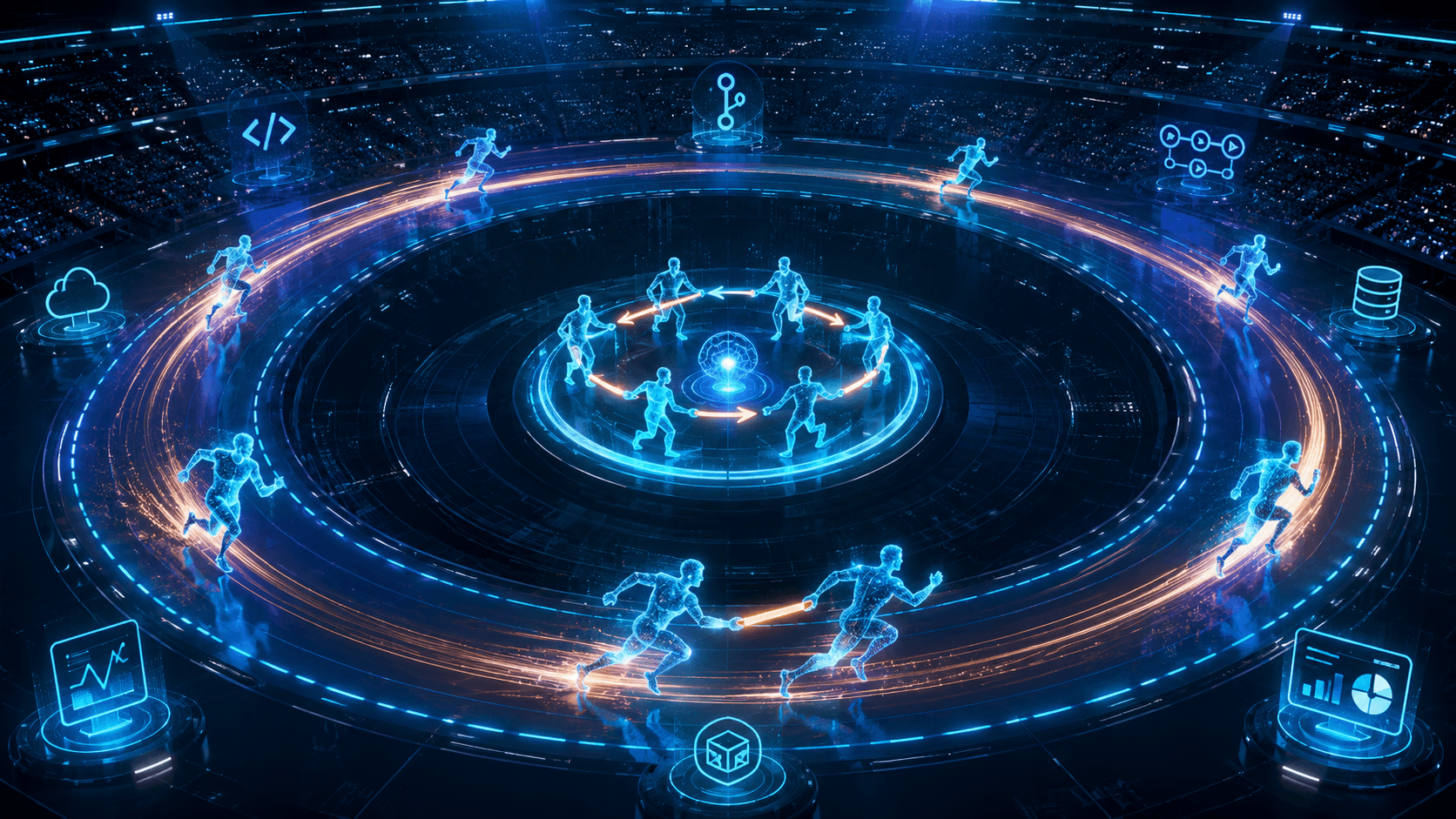
Most data work does not fail because one person ran too slowly.
It fails because the track is too long.
A question starts with the business, moves through engineering, passes into analytics, lands in a report, and eventually comes back as feedback. Every handoff adds distance. Every distance creates another chance to lose context.
For years, we tried to make each runner faster. Better ETL tools. Better BI tools. Better deployment systems. Better project management.
Useful, but incomplete.
Agents change something more fundamental. They do not just make the runners faster. They shorten the track.
When an agent can move between code, Git, deployment systems, logs, APIs, databases, notebooks, semantic models, and reports, the work stops behaving like a long relay. It starts behaving like a tight feedback loop.
The Relay Race Problem
The running is not the risky part of a relay.
The handoff is.
One runner arrives at full speed. The next is already moving. The baton has to pass inside a narrow exchange zone without either person drifting out of sync. The faster the runners move, the more precise that exchange has to become.
Data work has the same problem.
A stakeholder starts with a question. A data engineer pulls the source, builds the pipeline, and shapes the upstream tables. An analyst builds the model and report. The stakeholder reviews the result and decides whether it answers the original question.
If it does not, the team starts another race.
New clarification. New ticket. New query. New transformation. New validation pass. New report review.
And the baton is not merely the task. It is the context surrounding it: the business meaning, assumptions, edge cases, validation rules, and the detail mentioned in a meeting that never made it into the ticket but changes how the answer should work.
The farther that context travels, the easier it is to drop.
This is why data teams need so much process around the work. Requirements documents, status meetings, acceptance criteria, deployment checklists, and validation spreadsheets are not pointless bureaucracy. They are the cost of keeping a fragile baton moving across a long course.
Agentic workflows change the geometry.
The handoffs do not disappear. Code still moves into deployment. Output still moves into validation. Business feedback still has to reach the transformation that produced the result.
But every correction no longer has to begin a new race.
The work becomes less request, handoff, finish, restart.
More observe, adjust, validate, repeat.
That is what it means to shorten the track.
The Pipeline Was Green. The Data Was Wrong.
I saw this while building a pipeline that moved operational data from an enterprise operations system through AWS and into Microsoft Fabric.
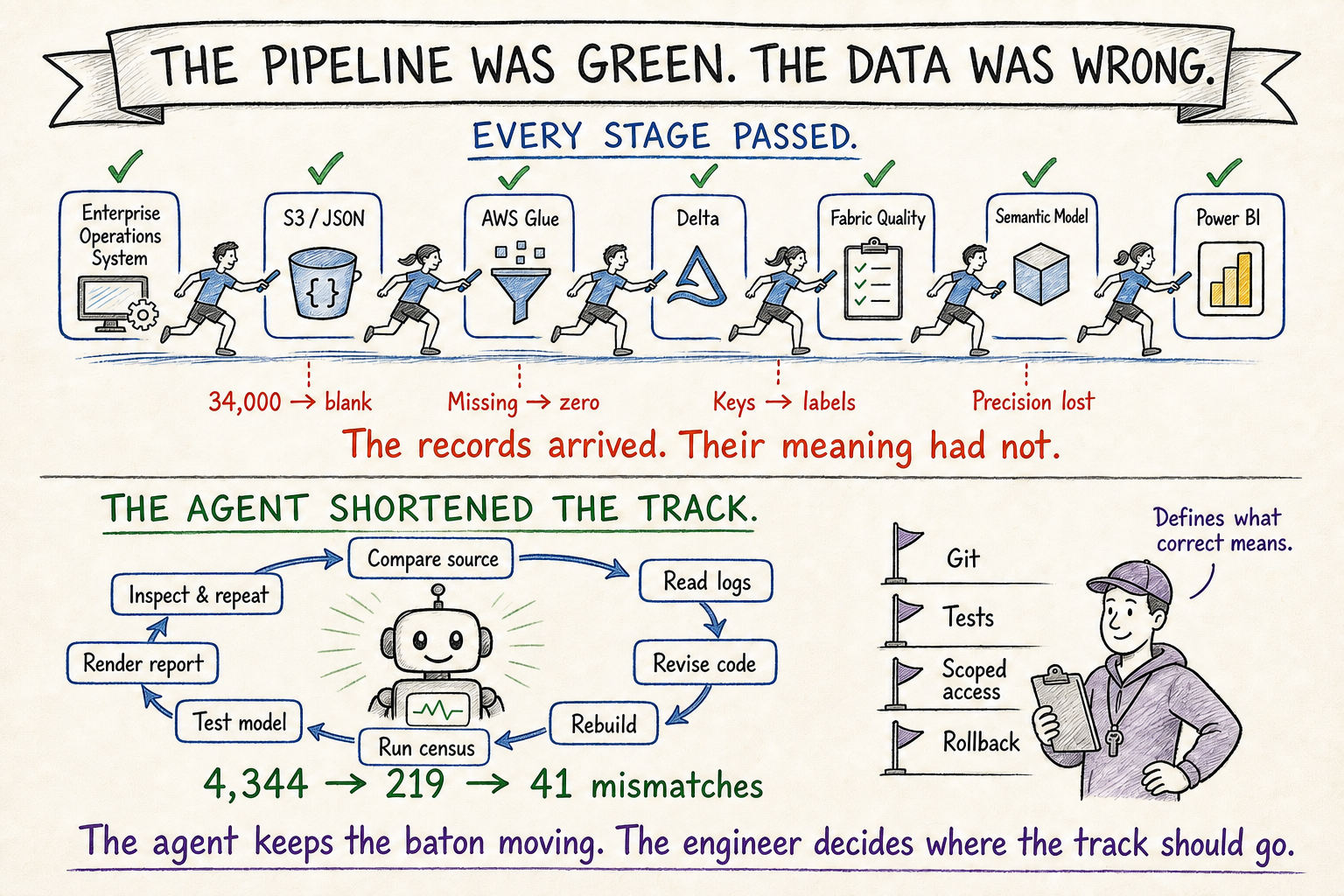
A managed connector pulled the source records into Amazon S3 as JSON. An AWS Glue job converted those records into Delta tables. From there, Fabric carried the data through quality reporting, a semantic model, and the final Power BI report.
On an architecture diagram, that looks like a clean sequence of boxes.
In practice, every box is an exchange zone.
Did every source record land in S3? Did the Glue transformation preserve the values and types? Did the Delta tables still match the source? Did the semantic model calculate the business measures correctly? Did the finished report show what we thought we had built?
The jobs completed successfully.
The data was still wrong.
One capacity field contained a value of 34,000 in the source system. In Delta, the field appeared to stop at 900.
The problem was not the source. Larger values arrived with thousands separators, and the transformation did not clean them before trying to convert them into numbers. Instead of throwing an error, it quietly replaced those values with blanks.
The more significant the number became, the more likely it was to disappear.
That was not the only defect. Some inherited categories arrived completely empty. More than 13,000 related records carried labels where relationship keys belonged, breaking downstream joins. Missing duration values became zeroes. Currency values lost precision through rounding.
A row count would have declared the pipeline healthy. The records had arrived.
Their meaning had not.
This is where the agent became more than a faster code generator.
Because the workflow was exposed through files, APIs, and logs, the agent could compare the transformed data with the original JSON, query the source API for a separate sanity check, inspect the Glue logic, find patterns in the mismatches, change the transformation, rebuild the tables, and check the results again.
In one table, the first field-by-field census found 4,344 mismatches. After the next rebuild, 219 remained. After another, 41.
The value was not simply that each fix happened faster. The agent could remain with the problem across the full loop. A mismatch in Delta could lead back to the raw JSON, into the AWS logs, and finally to the exact transformation that changed the value.
The failures also became tests.
Large formatted numbers had to survive conversion. A missing duration had to remain missing instead of quietly becoming zero. Currency had to preserve the precision the source supplied. Relationship keys had to remain keys.
If those assumptions broke again, the pipeline would no longer be allowed to fail politely.
I still had to define what correct meant. The agent could show me that a blank became a zero. It could not decide whether zero was a valid business value or a fabricated contract term. It could expose a difference in precision. It could not decide how much precision the business actually needed.
Those were not coding questions.
They were meaning questions.
The agent could keep the evidence and implementation close together. I remained responsible for deciding which evidence represented the truth.
One Loop Across Two Platforms
The feedback loop did not stop when the data left AWS.
Inside Fabric, the agent could continue into the quality results and semantic model. It could compare a measure with the Delta data underneath it, change the definition, and push the next version. The Fabric APIs could render the final Power BI report in the browser or export it to PDF, creating another feedback signal from the experience a user would actually see.
That reach matters because the BI layer has historically been one of the least legible parts of the lifecycle.
A transformation usually exists as Python or SQL. A report often hides its logic behind clicks: relationships, measures, filters, formatting, interactions, and page layout. A person can open the interface and understand what was built. An agent needs the same work exposed in a form it can read and change.
When supported Fabric and Power BI assets are represented as files and code-backed definitions, the report becomes closer to software. The agent can inspect how the pieces relate, compare revisions in Git, modify a measure or configuration, push the change, and check the rendered result. The UI still matters for exploration and human review. It is no longer the only doorway into the work.
That turns the report from a finish-line artifact into another part of the feedback loop.
A visual problem could lead back to the model. A broken measure could lead back to the Delta table. A bad value in the table could lead back through the Glue transformation to the original record.
That is a very different workflow from finishing the AWS portion, handing the output to the Fabric portion, finishing the model, handing that to the report, and waiting for someone to notice that 34,000 had disappeared somewhere along the way.
AWS was still AWS. Fabric was still Fabric. S3, Glue, Delta, the semantic model, and Power BI remained separate pieces.
The agent made them behave like one loop.
That loop depended on something less glamorous than AI: good logging.
An agent cannot reason about a system it cannot see. The Glue job needed to expose what it received, what it changed, what it rejected, and what it wrote. The data needed stable checkpoints that could be compared with the source. The final report needed a form the agent could inspect.
The agent did not remove the need for observability. It made observability more valuable.
Once the lifecycle became readable, each stage could send evidence directly back to the stage that produced it. The AWS logs were no longer somewhere else. The source records were no longer somewhere else. The model and report were no longer finish-line artifacts waiting for a human to open the right interface.
Logs provide the evidence, but the rest of the operating layer needs to be reachable too. Git provides a checkpoint. Files expose the transformation. APIs expose the source and platform state. Tests preserve the rules discovered during validation. Code-backed definitions give the agent something concrete to revise.
None of those pieces is new on its own. What changes is that the agent can work across them without shedding the context at every boundary. It can carry a failed quality check back to the code, carry the next result forward into the model, and carry the rendered report back into another revision.
The systems do not become one platform. They become one working surface.
Same tools.
Different geometry.
That is the new operating layer: not one magic platform, but a shared, scriptable surface where the agent can move between the systems involved in delivery while the context is still warm.
Data Can Fail Politely
Application failures are usually loud.
The deployment breaks. The endpoint crashes. The logs show an exception. Everyone agrees something went wrong.
Data can fail politely.
A pipeline can complete while replacing valid numbers with blanks. A notebook can finish while duplicating rows. A semantic model can refresh while calculating the wrong total. A report can load beautifully while pointing the business toward the wrong decision.
In data work, green does not always mean good.
That is why agents matter more as feedback compression than code generation.
Writing SQL faster is useful. Writing a Glue script faster is useful. Generating a DAX measure faster is useful.
But the larger opportunity is following the result across the messy middle: source data, transformation logic, storage, quality checks, semantic modeling, report design, and business validation.
The agent should not stop at, “Did it run?”
It should help us ask: Did the values survive? Did the schema drift? Did the join multiply records? Does the measure still match the business definition? Did the finished experience communicate the result correctly?
That is the difference between automating a leg of the race and shortening the track.
A Shorter Track Still Needs Lanes
Faster feedback does not remove the need for engineering judgment.
It increases it.
When an agent can change the transformation, rebuild the data, revise the model, and inspect the report, a weak assumption can travel farther and faster than it could before. The same loop that accelerates a good correction can also compound a bad one.
Git still matters. Review still matters. Environment separation, scoped credentials, automated tests, validation checks, and rollback paths matter more, not less.
The tests from this pipeline are a good example. Each defect became a boundary around future work. The agent could continue iterating quickly because we had made the definition of failure more explicit.
That is what the lanes are for.
The goal is not to let an agent sprint blindly through production. It is to let the agent move safely inside a loop the engineer designed.
The human role moves up the track.
Less time walking between tools. More time defining what good looks like. Less manual translation between platforms. More attention to validation, architecture, and business meaning.
The agent can keep the baton moving.
The engineer decides where the track should go.
Stop Optimizing the Relay
Most data problems are not solved in one perfect pass.
The pipeline is almost right. The table is almost shaped correctly. The measure almost matches the business definition. The report almost answers the question.
Then the real work begins.
In the old model, every “almost” starts another race.
In the agentic model, every “almost” can become the next handoff inside the same loop.
That is the shift.
Not AI as autocomplete. Not AI as a SQL generator. Not AI as a dashboard feature.
AI as feedback compression.
The future of data development is not a faster relay race. It is a shorter track, clearer lanes, and a feedback loop tight enough to catch the difference between data that arrived and meaning that survived.