
Early-stage companies feel like solo musicians.
There’s one system of record, one spreadsheet that “everyone uses,” and one shared understanding of what the numbers mean. If something looks off, you notice immediately. If a value changes, you know why. The system isn’t sophisticated, but it’s internally consistent.
Growth changes that.
New teams arrive. New tools are adopted. Sales, finance, operations, and product each bring in systems built for their own needs. Every system plays its part well — but each one is tuned locally, optimized for its own role, and maintained by people who don’t hear the full performance.
Before long, the business isn’t a soloist anymore. It’s an orchestra.
And that’s where the real challenge begins.
The problem isn’t that data stops being collected. It’s that accuracy, alignment, and meaning start to drift. Two systems share an identifier, until one team changes how it’s generated. A field keeps the same name, but its meaning quietly shifts. Nothing breaks outright. Reports still load. Dashboards still refresh. But the music starts to sound off.
This is the moment many organizations mistake noise for complexity.
They add more dashboards. More exports. More manual checks. But what they’re missing isn’t another instrument — it’s coordination, tuning, and a shared score.
That’s why data engineering exists.
Its job is to keep the orchestra playing the same piece, in the same key, at the same tempo — even as it grows. Volume was never the problem.
Every System Plays a Different Instrument
As organizations grow, new systems aren’t added randomly. They’re introduced to solve specific problems.
Sales adopts a CRM to track leads and deals. Finance brings in billing and accounting software to manage revenue and compliance. Operations uses tools optimized for fulfillment, logistics, or support. Each system is well-designed for its role — and poorly suited for the others.
In an orchestra, a violin, a trumpet, and a percussion section don’t produce the same sound. They aren’t supposed to. Each instrument is tuned for a different range, a different rhythm, a different purpose. Asking them to sound identical would defeat the point.
The same is true of data systems.
A CRM optimizes for activity and pipeline. An accounting system optimizes for accuracy and auditability. An operational database optimizes for speed and reliability. None of them are wrong — but none of them are aligned by default.
This is where drift begins.
Two systems might share a customer identifier, until one team changes how it’s generated. A field might keep the same name, even as its meaning shifts to support a new workflow. A value that once meant “final” quietly becomes “best guess.” Each change makes sense locally. Taken together, they pull the orchestra out of tune.
And the most dangerous part is that nothing obviously breaks.
The systems keep working. Reports still load. Dashboards still refresh. But now, strategic decisions are being made based on a performance that is subtly, dangerously out of tune.
This is the point where data engineering becomes necessary — not to replace the instruments, but to make sure they’re playing the same piece.
Tuning Gets Harder as the Orchestra Grows
What works for a small ensemble breaks down in a full orchestra.
In a quartet, musicians can adjust by ear. If one instrument drifts slightly sharp, the others compensate. The group self-corrects in real time. Informal coordination is enough.
Organizations behave the same way early on. When there are only a few systems and a handful of stakeholders, inconsistencies are visible. Someone notices a mismatch, asks a question, and the issue gets resolved manually.
Scale changes that dynamic.
As more systems are added and more data flows through them, small inaccuracies stop being noticeable and start being structural. A slight mismatch in an identifier becomes thousands of orphaned records. A loose definition turns into competing reports used in different meetings. Local fixes no longer propagate globally.
The orchestra is still playing — but no one can hear the whole thing anymore.
At this point, relying on informal tuning becomes impossible. You can’t ask every section to listen to every other section. You need shared references. You need agreed-upon timing. You need a way to detect when something is drifting before it becomes part of the performance.
This is where data engineering shifts from being helpful to being essential.
Its role is to introduce structure that scales:
-
Common references everyone tunes to
-
Clear timing so systems stay in sync
-
Mechanisms to catch drift early, before it compounds
How much structure is its own question, and the answer is rarely the maximum available. Formal data modeling earns its keep in some places and turns into over-engineering in others. What matters at this stage is narrower: whatever structure exists has to be shared.
Without that structure, the organization doesn’t slow down — it just gets louder. More data, more dashboards, more confidence — all built on a performance that’s slowly slipping out of tune.
And that’s when the hardest problems appear, driven by data that is almost right. Missing data announces itself. Almost-right data does not.
The Conductor: Coordination Is an Active Job
Even with perfect sheet music, an orchestra doesn’t run itself.
Someone has to set the tempo.
Someone has to cue the sections.
Someone has to notice when a group is rushing or dragging and correct it in real time.
That’s the conductor.
In a growing organization, shared definitions alone aren’t enough. Systems change. Teams optimize locally. New instruments are added mid-performance. Left unattended, even the best score slowly falls out of sync with reality.
This is where data engineering steps in as an active coordinating role.
The role carries no instrument of its own, and no authority over how each section plays. It is responsible for keeping the performance coherent as conditions change.
The conductor doesn’t tell the violinist how to play every note. They ensure the violins come in at the right moment, at the right tempo, in the right key — relative to everyone else. In the same way, data engineering doesn’t own every system. It owns the interfaces between them.
That includes:
- Ensuring shared identifiers stay aligned as systems evolve
- Detecting when upstream changes will affect downstream meaning
- Deciding when the score needs to be updated — and communicating that change
This work is mostly invisible when it’s done well. No one applauds the conductor for preventing a train wreck that never happened. But remove the role, and the performance degrades quickly — not into silence, but into confident noise.
Data engineering exists because coordination doesn’t emerge on its own at scale. It has to be maintained, continuously and deliberately.
Who Gets to Listen: Governance, Access, and the Audience
An orchestra doesn’t invite the audience onto the stage.
That is a matter of clarity rather than control. Musicians need space to rehearse, adjust, and sometimes play the wrong notes. The audience, on the other hand, comes to hear the music, not to watch every tuning decision in real time.
Data works the same way.
When people ask for raw data, it’s rarely because they want to write the sheet music themselves. It’s because they aren’t hearing the music they need. The answer they’re looking for isn’t coming through clearly, or it’s taking too long to arrive. So they ask for the only thing that feels flexible: the data itself.
That’s an understandable instinct — and a dangerous one.
Handing out raw data pushes interpretation downstream. People download it to their laptops, reshape it in spreadsheets, apply their own assumptions, and share the results informally. Before long, the same performance is being replayed dozens of times, each with slightly different timing, emphasis, and meaning. No one is malicious. But no two versions sound quite the same.
This is where governance often gets misunderstood.
Governance isn’t about restricting curiosity. It’s about preserving shared understanding while still enabling exploration. The goal isn’t to keep people out — it’s to make sure experimentation happens in a way that doesn’t fragment the performance.
Done well, data engineering creates a flexible process for interpretation without handing everyone a different score.
Think of it less like a locked concert hall and more like a structured improvisation.
The audience can request the song—they can ask for a new metric or a specific revenue cut—but they don’t grab the violins to rewrite the sheet music mid-performance.
In a good orchestra, musicians respond to those requests, adjust the mood, and riff—but always within a known framework.
That’s what a healthy data process looks like.
Instead of forcing users to ask for raw data because answers are slow or unclear, the system shortens the path from question to insight. Curated views, governed datasets, and shared tools like Power BI allow people to explore, slice, and ask follow-up questions — all while staying anchored to the same underlying performance.
Raw data stays backstage, where it can change safely.
Exploration happens on stage, where it stays visible and shared.
When this balance is right, people stop asking for the data because they finally hear the music they were asking for in the first place.
What a Tuned Orchestra Can Play
Once the music is clear, the payoff is usually described in terms of reporting. Faster dashboards. Cleaner metrics. Fewer arguments about whose number is right.
That undersells it. A coordinated data layer is the foundation custom software gets built on.
I have built this. The domain below is changed, the shape is not.
A team tracks incoming feature requests on a board, the kind of thing Monday and its competitors do well. The board holds the pipeline, the stages, and who owns what. But the decision to move a request forward depends on information the board has never seen: which accounts asked for it and what they are worth, how those accounts use the product today, and what they actually said when they asked.
So the real work happens somewhere else. Someone pulls the account list. Someone else goes back through the support tickets and call notes. The board records the outcome after the fact.
We built an application on top of that board. It joined the requests to account and usage data on account identity, with cleanup, because that kind of join always needs some. It pulled the customer conversations in automatically from the tools where they already lived. And it let people move a request into the next stage from inside the app.
That last part is the one that matters. The application reads from the data layer and writes back into it. It is a place where work happens, rather than a window onto work that happened elsewhere.
Requests reached a decision faster as a result. The relevant information was visible in one place, so the things that would kill a request surfaced early instead of emerging after a sequence of separate analyses. We spent less time getting to the point where we could tell a request was not worth building.
The board stayed in place through all of this. We ran on top of it and started replacing the specific features we actually used.
That approach is worth sitting with, because most teams use a fraction of what a tool like Monday can do. They pay for the whole thing, and the fraction they use sits apart from everything else in the business. Running alongside first, then absorbing the pieces that matter, turns replacement into something incremental instead of a migration nobody wants to sponsor.
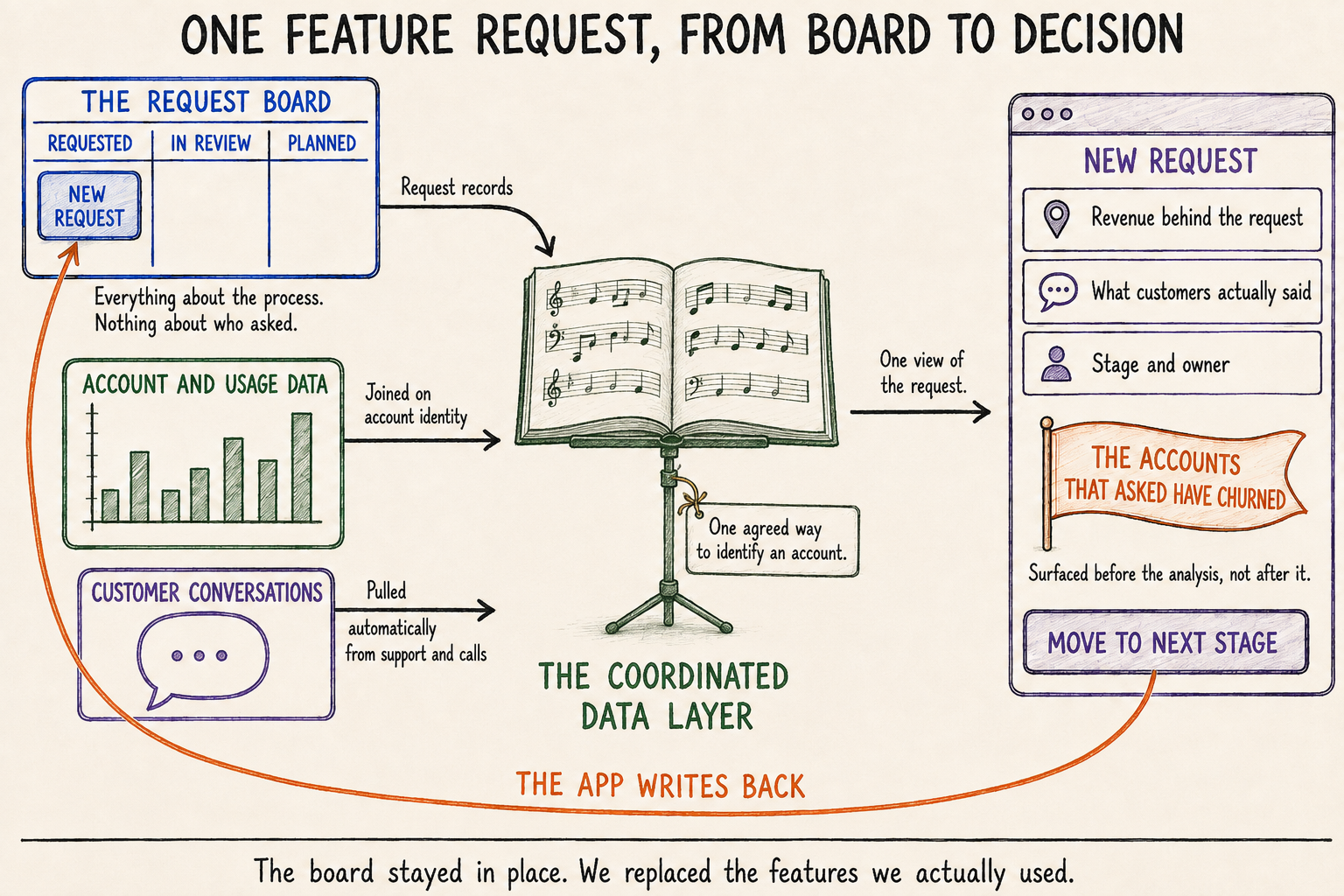
The board held the process. The score held everything the decision actually needed.
The Score Is What Makes It Possible
None of that application works without the coordination described above.
It joins a request on the board to accounts in the product database. That join means something only if both systems agree on which account they are describing, and on a board where customers get typed in by hand, Acme, Acme Corp, and ACME Inc. are three different customers until someone decides they are not. Shared identifiers, stable grain, and cleanup where the systems disagree are conductor work, and they are the precondition for the application rather than its aftermath.
There is a version of this that assumes the model will simply work it out — point something intelligent at the raw tables and let it infer what a completed transaction is, or which account record is authoritative.
In an orchestra, some things are not open to interpretation. The key is fixed. The tempo is set. The score is authoritative.
Data works the same way. How data is ingested, what counts as a closed deal, what "revenue" means — these are decisions, and in operational and financial contexts a probabilistic guess at them is a liability. Data engineering is where those decisions get made and held steady.
Which is also why the goal was never to make as much data as possible analysis-ready. Coordination was the constraint, not volume. A hundred tables ingested "just in case" contribute nothing to building this application. One reliable way to identify an account contributes everything.
What has changed is the cost of the application itself.
For years the calculus was simple. A custom internal tool cost more to build and maintain than the gap it closed, so teams tolerated the gap, exported to spreadsheets, and kept the analysis in someone's head. Building the thing was possible and rarely worth it.
Agentic development moved that line. When an application can be produced in days by the person who already understands the data, the tools worth building are no longer limited to the ones that justify a dedicated engineering team. I wrote more about that shift in I stopped writing code and started producing software.
The data layer determines whether that speed produces something durable. Build on aligned definitions and the application inherits them. Build on systems that quietly disagree and you have produced a very fast way to distribute an inconsistency.
AI rewards preparation. It has no way to supply it.
Why Data Engineering Exists
Early on, a business can get away with being a soloist.
One system. One spreadsheet. One shared understanding of the numbers. The system isn’t sophisticated, but it’s internally consistent — and that consistency is enough.
Growth changes that.
As organizations add systems, teams, and complexity, they don’t lose data. They lose alignment. Instruments drift. Meanings diverge. Interpretation fragments. The orchestra keeps playing, but fewer people are hearing the same performance.
Data engineering exists to prevent that outcome.
It keeps instruments in tune as they evolve.
It maintains the score everyone plays from.
It ensures that interpretation happens within shared boundaries, not in isolation.
This isn’t about control for its own sake. It’s about preserving trust as scale increases. About shortening the distance between questions and answers without sacrificing consistency. About making sure that when the business listens to itself, it hears one coherent piece — not a collection of rehearsals.
AI has intensified that need. As interpretation gets faster and more automated, and as more of the software a business runs on is assembled from its own data, the quality of the underlying music matters more than it ever did. Agents can write new sections of the score and explore variations at speed. They still depend on a conductor, a clear score, and well-tuned instruments.
Data engineering works behind the performance rather than in the spotlight. It is also what makes the performance possible — the reports, the applications built on top of them, and the decisions both exist to support.
As organizations grow, specialize, and build more of their own software on their own data, that role becomes foundational.
At scale, success comes from playing together.