
Why We Built the Museum
Archaeologists do not dig up everything.
They fan out across sites and bring back what they can find. A bone from one place. A coin from another. Pottery shards that might belong to the same century, or might not. Before any of it can tell a coherent story, someone has to clean it, label it, establish where it came from, and decide how it fits with everything already known.
So they build the museum.
The museum gives scattered artifacts a home. It organizes them by era, geography, and meaning. Conservators standardize what arrived in different conditions. Curators decide which pieces belong together. A map helps visitors move through the collection without needing to understand the excavation behind it.
That is what building a data warehouse feels like.
Fragmented systems are the dig sites. Pipelines carry records in from every direction. Transformation work cleans and reconciles what arrives. Data models become the curated story. The BI layer gives people a map through the collection.
And it worked.
Dashboards got built. Reports became trusted. Definitions stopped changing every time someone wrote a new query. The business gained a carefully organized account of what happened across systems that could not answer those questions on their own.
The warehouse solved an important problem: it gave the business a memory.
But memory is not the same thing as awareness. And awareness is not the same thing as control.
The original city those artifacts came from?
It kept moving.
The City Kept Moving
Imagine you are not a museum visitor. You are a city manager.
Your job is to keep the buses running, respond to the burst pipe on the east side, flag the permit that has been sitting unanswered for three weeks, and get ahead of the traffic backup before it becomes a problem.
The museum can show you how the neighborhoods developed, where the infrastructure was laid, and which districts grew fastest. That history is useful. It may be the best context available for deciding where to look.
But it cannot tell you whether the number 14 bus is stalled right now. It cannot reroute traffic. It cannot approve the permit.
That distinction matters because operational work is shaped by timing. The historical pattern may tell you that a neighborhood is vulnerable to water-main failures. The live alert tells you which pipe broke this morning. The work-order system tells you whether a crew has been dispatched. Each layer adds something the others cannot provide.
This is the position many organizations create for their AI systems. They connect an agent to the warehouse because that is where the data became consistent and trustworthy. Then they ask it to do operational work.
The limitation is not simply that warehouse data is old. A warehouse can refresh every night, every hour, or every few minutes. The deeper issue is that it was designed primarily to support analysis. It can describe the business without necessarily exposing the controls that run it.
An agent connected only to that environment can be a capable analyst. It can summarize last quarter, explain a trend, compare cohorts, and surface an unusual pattern.
But an operational agent needs another kind of connection.
It needs to see what is happening in the live systems now. It needs a path to the workflow where the issue can be resolved. And when it is allowed to act, it needs clear boundaries around what it can change.
The warehouse tells the agent what has been true. Live systems tell it what is true now and give it somewhere to act.
Operational agents need both.
The Overdue Invoice That Wasn't
Consider a finance team starting Monday with an overdue-invoice report from the warehouse.
One account stands out. A $184,000 invoice is twelve days late. The customer has paid slowly twice before, the contract is significant, and the account team has a call scheduled that afternoon. Based on the history, this deserves attention.
The row is red. The account appears near the top of the collections queue. Someone needs to decide whether to contact the customer, escalate internally, or wait. The report has done its job: it has turned thousands of transactions into a short list of things worth investigating.
That is the museum doing exactly what it should do. It has assembled records across time, applied consistent definitions, and identified the artifact worth examining.
But the report is not the situation.
The normal next step is a small investigation spread across several systems. Copy the account number. Open the ERP. Search the bank feed. Check the CRM. Ask whether anyone on the account team has heard from the customer. Each handoff is simple, but together they create enough friction that the red row can easily become a collections email before anyone reconstructs what actually happened.
An agent can stay with the question across those boundaries.
It checks the live ERP and confirms that the invoice is still open. Then it checks the bank feed and finds a payment for the exact amount posted that morning. The remittance references the customer's parent company rather than the legal entity on the invoice, so the payment is sitting unapplied. A note in the CRM confirms that the customer sent the remittance details on Friday.
The account is not refusing to pay. The business has received the money. The remaining problem is an internal matching exception.
That changes the conversation before the account team ever gets on its afternoon call. Instead of asking the customer why payment is late, the team can explain that the payment was received and that the internal exception is being resolved. The same historical signal now leads to a very different action.
If the agent worked only from the warehouse, it might draft an unnecessary collections message or escalate the account as a renewal risk. If it worked only inside the ERP, it might see the unmatched payment without understanding the customer's history or why the account deserves immediate attention.
Together, the systems tell a more complete story.
The warehouse supplies the historical signal. The ERP supplies the current financial state. The bank feed supplies evidence of the transaction. The CRM supplies relationship context. The operational workflow supplies the place to resolve the exception.
The agent can assemble that evidence, propose a match, draft the note that removes the account from the collections queue, and route the financial change to the right person for approval. Once the exception is resolved, the outcome becomes part of the history used the next time the account needs attention.
That is the loop.
Not warehouse or source systems. Memory, awareness, and action connected around a specific job.
The value is not merely that the agent found more data. It is that the question did not lose its context as it crossed system boundaries. The agent could keep investigating until the signal became an explanation and the explanation became a safe next step.
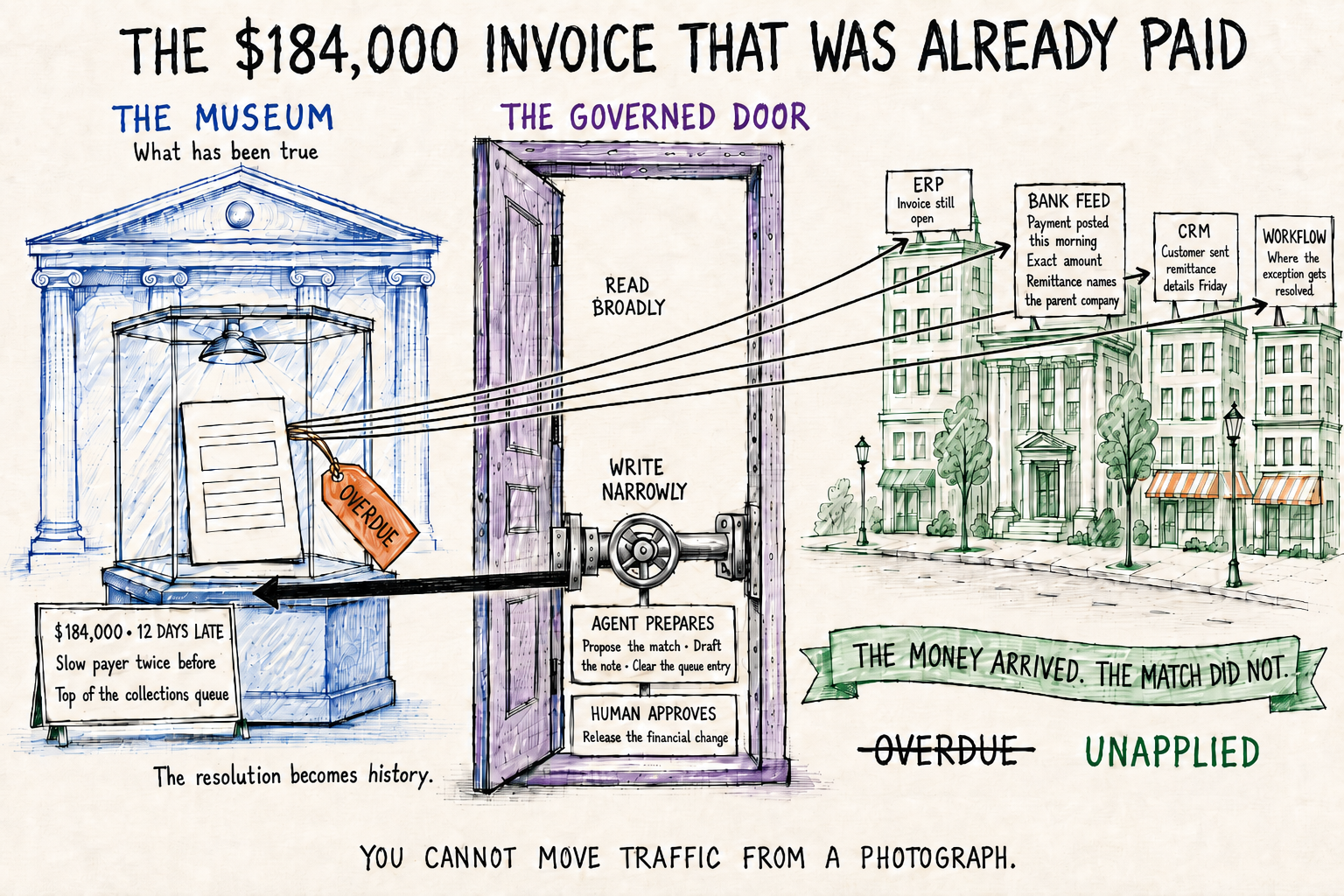
History raised the signal. The live systems explained it. One gated write resolved it.
Context From the Museum, Action in the City
For a long time, data architecture concentrated on the path into the warehouse. Pull the records. Clean them. Reconcile the definitions. Make them available for reporting. The difficult work happened before the question could even be asked, so most of the function's energy went into building and maintaining that path.
Agents make another path increasingly important: the path from understanding back into execution.
Most analytical systems were designed to end with an answer. A metric changes, a dashboard draws attention to it, and a person carries that information into the next system by hand. The architecture succeeds at producing insight, but the workflow still depends on someone rebuilding the context at the point of action.
Operational agents make that final distance part of the design. The question is no longer only, "How does the data reach the report?" It is also, "How does the conclusion reach the workflow where something can change?"
The warehouse may still be the best place to decide what deserves attention. It holds the history required to identify a change, compare it with a baseline, or understand whether an event is unusual. It may contain derived measures that do not exist in any individual source system.
The live systems answer a different set of questions. Is the invoice still open? Has the support ticket already been resolved? Did the customer use the feature this morning? Is the approval waiting on someone? What actions are available inside the workflow right now?
Those systems are not inherently cleaner or more truthful. The live city is noisy. Records conflict. Notes are incomplete. APIs fail. A field in the CRM may reflect one person's interpretation while a modeled measure in the warehouse reflects a definition the company spent months agreeing on.
Connecting an agent directly to every source does not remove the need for data engineering. It changes where engineering judgment is applied.
The agent still needs reliable identities across systems, documented meanings, tested calculations, permissions, and a record of how it reached a conclusion. Moving faster without those foundations only makes it easier to act on the wrong answer.
This is why the museum and city are complementary rather than competing architectures. History gives an event significance. The live systems give it immediacy. Without history, the agent may react to noise. Without the live state, it may act on something that has already changed.
The architecture therefore has two complementary responsibilities. Give the agent enough analytical context to understand the situation, and give it the minimum operational access required to help resolve it.
The museum provides the map.
The city provides the controls.
Read Broadly. Write Narrowly.
Write-back is what turns an analytical agent into an operational one. It is also where a useful demonstration becomes a production responsibility.
Reading an overdue invoice is not the same as applying a payment. Summarizing a support case is not the same as closing it. Identifying a risky account is not the same as contacting the customer.
The more systems an agent can reach, the more complete its view becomes. Its potential blast radius grows at the same time. That is why access cannot be treated as one binary choice between read-only and fully autonomous.
The safest operating principle is simple: read broadly enough to understand the job, but write narrowly enough to keep the consequences controlled.
An agent can prepare a payment match without releasing it. It can draft a customer message without sending it. It can create a follow-up task while leaving a financial record untouched. As the workflow becomes better understood, specific actions can earn more autonomy. Consequential or irreversible actions can continue to require approval.
That means operational access should be deliberate. Permissions should be limited to the job. Actions should be attributable and logged. The agent should know the difference between proposing, approving, and executing. Wherever possible, its first actions should be reversible.
These controls are not friction around the agentic workflow. They are part of the workflow.
They also give the system room to mature. A team can begin with an agent that gathers evidence and recommends an action. Once that recommendation is consistently reliable, the agent might create the task or prepare the change automatically. Only well-understood actions with clear recovery paths need to move further. Autonomy becomes something the workflow earns, not something the technology assumes.
A city manager does not personally turn every valve or change every traffic signal. The control room provides visibility, authority is distributed, and important actions leave a record.
Agents need the same operating discipline.
The City Is Not Replacing the Museum
None of this is an argument for tearing down the warehouse.
The warehouse still has an essential job: historical analysis, cross-functional reporting, finance, executive measurement, durable definitions, and the long-term context that helps an organization understand where it has been. Some agents will work entirely within that world, helping people explore and explain it. That is useful work.
The mistake is expecting the same architecture, by itself, to run an operational process.
An agent investigating history needs the museum. An agent changing current conditions needs a path into the city. Many of the most valuable workflows will move between the two: begin with a historical signal, inspect the live state, take a bounded action, and return with a record of what changed.
That return path matters. Once the payment exception is resolved, the warehouse should eventually reflect the resolution. The museum keeps receiving new artifacts from the city, and the history becomes more useful because it includes not just what was discovered, but what the organization did about it.
That is the difference between insight and execution.
A conversational dashboard can tell you which support tickets are overdue. An operational agent can determine whether they are still blocked, prepare the next step, and move the work forward within the authority it has been given.
You cannot move traffic from a photograph.
But you should not run a city without a map either.
The opportunity is not to choose between the museum and the city. It is to build a governed door between them.
The city is right outside.