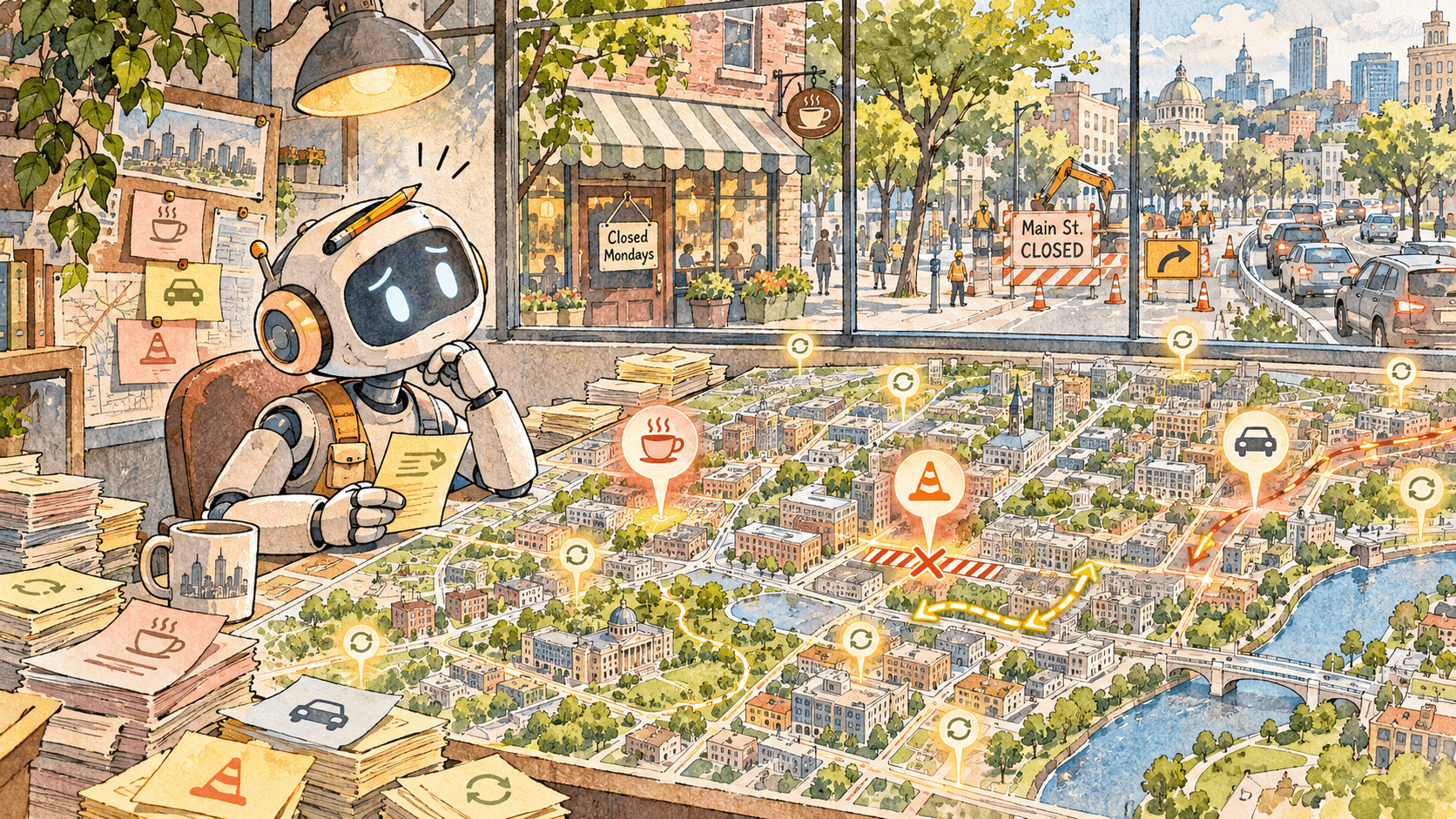
You check Google Maps before heading to a restaurant on Monday. The listing says eight to five, every day. When you arrive, the door has a handwritten sign: "Closed Mondays." The restaurant changed its hours. That change hasn't reached the map.
The map got you to the right building. It brought together the restaurant's location, the surrounding streets and the information you needed to plan the trip. The door had the newer answer about Monday.
A data warehouse does something similar for a business. It assembles records from separate systems into a shared picture that people can use without making those rounds themselves. But that picture reflects what had reached the warehouse when it was last updated. The source systems keep changing, and the copy can fall behind. Whether that gap matters depends on what you're using it for.
Agents make a fresh check more practical. A question that once sent someone through billing, the CRM and the bank portal can start a focused investigation across those systems. Sometimes the warehouse is current enough. Sometimes a few source checks will do. Sometimes the decision needs a continuous feed. How fresh does the answer need to be when someone acts on it?
Assembling the map is real work
The map on your phone brings roads, buildings, addresses, business hours and bus routes into the same geography. You can find a cafe, see which bus stops nearby and work out how to get there. Those details become useful together.
Google describes combining Street View and satellite imagery, authoritative datasets and contributions from businesses and users. Producing the shared map involves identifying places, bringing observations together and checking corrections. Google's explanation of how it maps the world
Consider the cafe at 17 Main Street in the illustration below. An image supplies the shape of its building. An address register identifies the street number. A business listing supplies the name and hours. A timetable locates the nearby bus stop, while a roadworks notice applies to one segment of the bridge.
The work is connecting each observation to the right thing. The building and the business inside it have different identities. A new owner can change the cafe's name while the address stays the same. One building can contain several businesses. A road restriction needs to land on the affected stretch of road.
Business records have the same problem. Billing knows a customer's legal name, the CRM uses an account name, and a bank payment arrives under the parent company's name. Joining those records takes decisions about which customer each describes, how parent and subsidiary accounts relate, and which identifiers can be trusted. A similar name alone is a poor reason to merge two accounts.
The shared data model makes those relationships reusable across reports, analysts and agents. A customer question can start from a known account and its related records.
The map also needs a legend. A business needs to decide what an "overdue balance" includes: credit memos, disputed invoices, unapplied payments? Which date makes an invoice late? Those definitions belong with the shared model. An agent looking at newer records still needs to calculate the same number.
Refreshing the wrong customer match more often will reproduce the wrong answer faster. The records have to agree on who and what they describe.
The view you get by stepping back
Standing outside the cafe can tell you what is on its door. It takes a map with business details and neighborhood boundaries to ask how many cafes each neighborhood has, or which areas have poor access to public transport.
A warehouse gives a business that broader view. "How many invoices are more than thirty days late, across every customer?" requires a population of records, consistent dates and a shared definition of the balance. It is a different workload from opening one customer's invoice.
An application database may be able to answer both. The broad calculation still has to read and combine records while the application serves its users. An analytical store can carry that work separately, prepare commonly used relationships and reuse the result across reports. With columnar storage, a calculation can read just the fields it needs.
It would take many visits to count every cafe in town. Sending an agent to retrieve every customer's invoices can recreate that collection work each time someone asks. The ability to make a source lookup cheaply doesn't make every question a source-lookup problem.
Keep the older editions
Suppose this year's map shows a cafe where last year's map showed a hardware shop. The current street tells you what is there now. The older edition helps answer what changed.
Business questions often depend on that distinction. An invoice's status today doesn't tell you what it was at last month's close. A customer's current sales region doesn't establish which region owned the account when last year's sale occurred. Recalculating old results using today's relationships can change the apparent history.
Keeping that history requires a choice. A pipeline might retain a snapshot at each month-end, capture changes as they occur, or preserve dated versions of selected records. A versioned customer record, for example, can retain its previous region and the period it applied to. That approach is called a Type 2 slowly changing dimension.
Decide what must survive before it disappears. Some source systems keep detailed audit logs; others keep limited history, or make it difficult to retrieve. Replacing each old value with the latest one in the warehouse loses that history too. A daily snapshot can miss changes made and reversed between snapshots.
An agent can retrieve an older version if one was retained somewhere it can access. Asking the source today cannot recover a past state that nobody recorded. This is one reason a prepared analytical store remains valuable even when current records become easier to query.

Each layer has its own clock
The road layout might still be useful months after it was collected. A cafe can change its Monday hours overnight. Traffic on the bridge can change during the journey. The acceptable age of the information depends on which part of the decision it supports.
The change also has to make its way onto the map. Someone changes the opening hours, someone records or submits them, and the listing is updated. Google reviews Business Profile edits before they appear. Its aerial and satellite imagery is collected at particular times, and one image can combine photos taken on different dates.
Business data passes through similar stages. A payment happens, the bank records it, a feed makes it available, and the warehouse processes it. There can be delay at each step. Refreshing the warehouse every minute will keep retrieving the same bank data if that feed is only updated each morning.
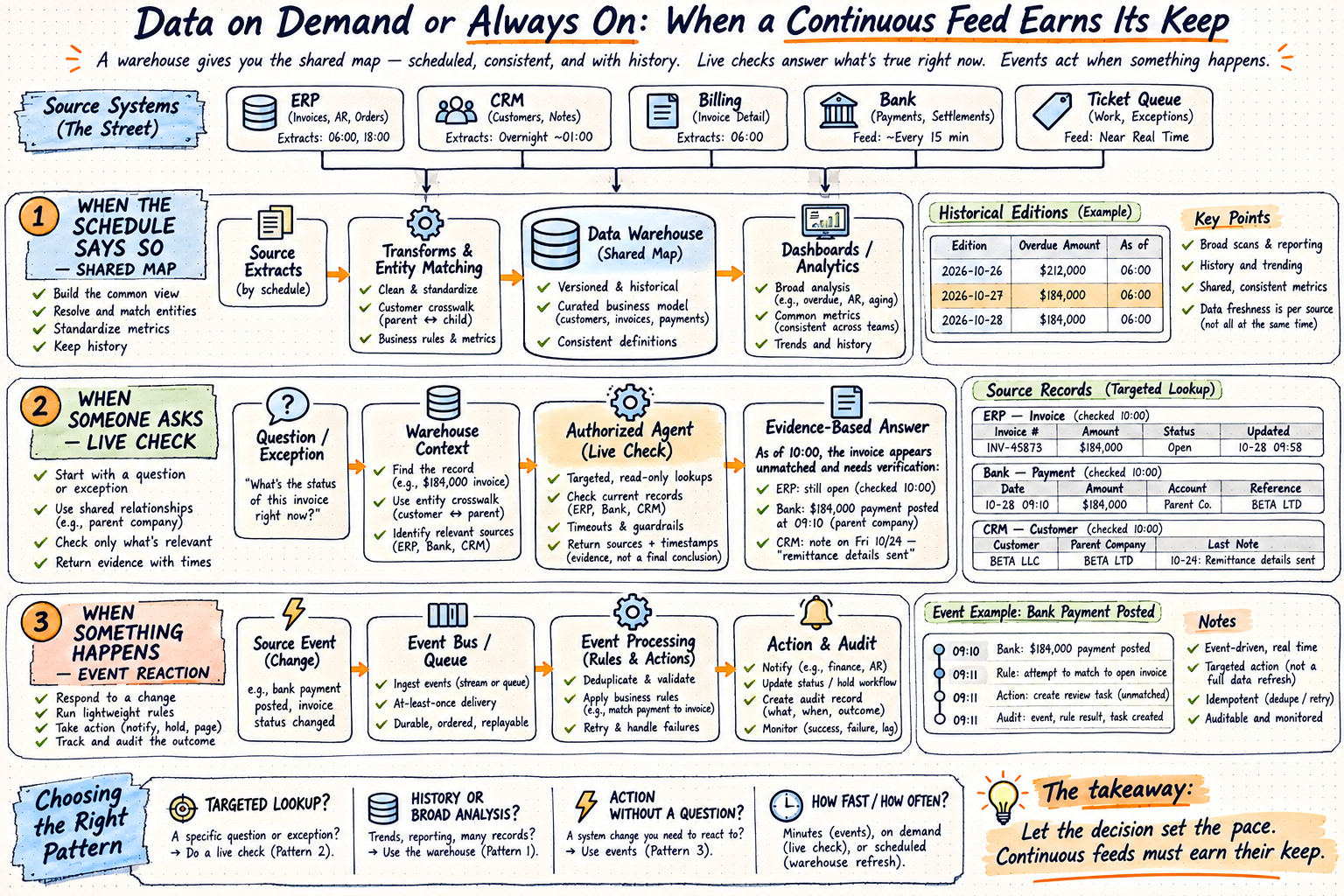
In the illustrated setup, ERP records are extracted at 06:00 and 18:00, customer details overnight, and bank transactions about every fifteen minutes. A dashboard opened at nine can combine all three. Its "last refreshed" timestamp tells you when a job ran; you also need to know which source updates made it into that run.
For a collections decision, the payment input may be the limiting factor. For a regional sales comparison, the customer assignments and their effective dates may matter more. Calling the entire dashboard "real time" hides those differences.
For lunch on Monday, the unresolved input is the opening hours. That gives the source check a specific job.
Why an occasional question became a feed
A manager asking where a customer stood today could send someone through four systems and back to the account team. The work could take an afternoon, then need repeating the next time someone asked. Preparing the answer in the warehouse saved those rounds.
So when the manager said, "I need this in real time," data teams built a feed. Pipelines collected changes, joined the records and refreshed the dashboard. The answer was waiting when the manager returned.
Sometimes that was exactly what the business needed. Sometimes "real time" meant "when I open it, I want it to be current," and the dashboard was opened twice a week. An occasional question had become an obligation to keep a dataset current around the clock.
Maintaining a map means maintaining its connections to a changing city. A business closes, an address changes, a bridge is rebuilt. A data feed has its equivalents: renamed fields, changed identifiers, expired credentials, late files and records that no longer fit yesterday's assumptions.
Modern feeds can collect only what changed, so compute may be modest. They still need someone to notice missing updates, repair failures and establish that the result means what its users expect.
Agents change the effort of making the trip. The retrieval can follow the question, while the warehouse keeps the broader picture. On-demand checks still need maintained connections, permissions and verification. The choice now includes both the cost of keeping an answer ready and the cost of fetching it when someone asks.
The agent visits the places that matter
In a business, checking the street means visiting the ERP, CRM, billing platform or ticket queue. A person can make those rounds, search for records and reconcile what comes back. An agent with the right access and instructions can do the lookups when someone asks.
Take an illustrative finance team reviewing overdue invoices. Its overdue-invoice report reflects data as of 06:00. One row is red: a $184,000 invoice, twelve days late. The account team has a call with the customer that afternoon.
The warehouse has matched the invoice to the customer and put it among the other overdue accounts. Out of thousands of invoices, this is one worth a closer look.
At 10:00, the agent uses the customer relationships in the shared model to make three checks:
- ERP: the invoice is still open.
- Bank feed: a payment for the exact amount posted at 09:10 under the customer's parent company.
- CRM: a note says the customer sent the remittance details.
Together, the records suggest a payment waiting to be matched. The amount and company relationship are clues; they do not prove which invoice the payment settles. Finance can inspect the payment reference and remittance details before treating it as paid.
The conversation changes from "why are you late?" to "we've found a payment that appears to be yours; we're checking the matching issue."
The warehouse found the exception; the agent checked the records behind it. Preparing for this call required a few lookups in the bank, ERP and CRM. The rest of the customer population could wait for its next scheduled update.
The answer should carry the invoice, payment and note references, along with when each was checked. An agent connected only to the warehouse would miss the newer payment until a later refresh.
What a source visit can establish
The sign on the door answers the question about this cafe on Monday. Another branch or another day needs its own evidence.
An agent can report what the accessible systems recorded when it checked them. A payment missing from the bank feed might be delayed, rather than absent. An account note nobody entered will remain invisible. If access to the bank feed fails, that check is incomplete.
The systems can also change during the visit. Checking the bank, then the invoice, then the CRM produces observations from different moments. The answer needs to distinguish those observations from the agent's inference about a possible match.
The access guardrails in Before You Point an Agent at Your Data still apply: read-only access, time limits and a suitable database copy where one exists. A targeted investigation should stay within its intended records and workload.
One visit supplies an answer for a particular question. The agent's finding may help prepare this afternoon's call while the 06:00 report still shows an overdue invoice. Reusing it elsewhere requires deciding where the evidence is retained and how later processes will reconcile it. A one-off answer has a different life from a shared report that people keep opening.
A live layer can earn its place
A driver choosing a route across town has a different need from someone counting cafes by neighborhood. A traffic jam can change the useful answer before the driver reaches the next junction. Many people may need that update at once.
Google's traffic systems combine current observations with historical traffic patterns. The prepared road network, accumulated history and changing conditions work together to support the route. The same map can carry layers with different ages and update rates.
The decision recurs, delay changes the outcome, and preparing one current view serves many requests. Sending a separate investigator down every possible route each time a driver asks would duplicate the collection work. A live feed earns its keep here.
A dispatch team might need the same arrangement for vehicles, jobs and capacity. A finance team preparing occasional customer calls might be well served by a morning report and targeted checks. Different parts of the same business can justify different cadences.
The live layer can have a narrow scope. Keep vehicle positions current while historical invoices update on a slower schedule. A warehouse can receive selected changes continuously, and an agent can use its broader view to find the record worth inspecting. One system can combine all three approaches.
Freshness has value when a newer answer can change the decision in time. If the customer call is tomorrow, a dependable overnight update may be sufficient. If someone must make a routing decision while a driver waits, the answer may need to be ready already.
Asked, scheduled or triggered
Choose what starts the work, then decide how much information needs to be prepared for it.
When someone asks. Check the selected places. Retrieve the records needed for the question and return an answer with evidence. This fits occasional investigations whose users can wait for the checks. A more expensive investigation can still be worthwhile if it replaces hours of human effort and runs infrequently.
When the schedule says so. Update the shared picture before the decision. A report used in a Monday staffing meeting may need one dependable refresh beforehand. That schedule should allow time to detect and fix a failed load; starting the job at the meeting time would leave little room for recovery.
When something happens. A sensor-controlled traffic light responds when a car arrives, without someone opening the map. Similarly, a payment event can start a matching check, or a service failure can page the person responsible. The event initiates the work.
Updating a shared view and taking an operational action are separate jobs. A stream of vehicle locations can maintain a live map. A vehicle entering a restricted area can trigger a specific alert. Both use incoming events, but only one requires a continuously updated analytical view for people to consult.
The wiring still needs care. Events can arrive late, be repeated or fail to reach a consumer. Ordering and replay depend on the event service and its configuration. The process needs a way to recover and handle repeats without taking the same action twice.
Picture a one-time staffing analysis using six months of schedules and ticket volumes. Once the answer is in, a feed built solely for that analysis can stop, while records needed to reproduce it are retained. If the decision comes up every Monday, a scheduled update earns its keep. If staffing changes automatically when the queue spikes, that is the traffic light.
Let the decision set the pace
Before building a feed, I ask:
- How broad is the question? A few selected records may justify source lookups. Broad comparisons benefit from prepared data.
- Which version matters? Decide what must survive to answer questions about earlier periods.
- What has to agree? Keep identities and definitions consistent across reports and source checks.
- Where is the delay? Check when the source records a change, makes it available and delivers it downstream.
- How often is the answer needed, and how long can someone wait? Repeated demand or a short decision window can justify keeping it ready.
- Must something happen without anyone asking? Consider an event-triggered action and its recovery rules.
The map got you to the cafe. The sign answered the question about lunch. Live traffic would help if congestion threatened the journey. Keep each part current enough for the decision it serves, and let that decision earn the feed.